
Recent News
UNM-ISNPS researchers demonstrate remote operation and control platform of VSLLIM microreactor
September 28, 2026
National lab members visit Institute for Space and Nuclear Power Studies
September 9, 2026
El-Genk patents novel electromagnetic pump
September 8, 2026
Nuclear Engineering Chair joins UNM from Penn State
August 6, 2026
News Archives
UNM-ISNPS researchers demonstrate remote operation and control platform of VSLLIM microreactor
September 28, 2026
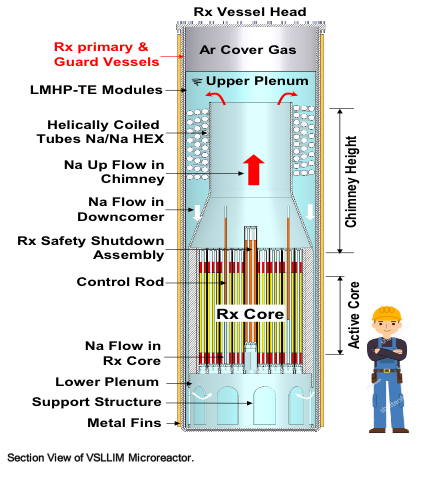
The University of New Mexico’s Institute for Space and Nuclear Power Studies (UNM-ISNPS) developed a secure, remote operation and control platform of the Very-Small, Long-Life, Modular (VSLLIM) microreactor. This fully passive walkaway safe microreactor design developed at the ISNPS has been licensed by UNM Rainforest Innovation to Eagle Nuclear Energy for commercial development and deployment.
The VSLLIM microreactor is factory constructed, assembled, and sealed and deployed either on a portable platform or installed at a designated site below ground and mounted on seismic isolation bearings. The VSLLIM nuclear microreactor can continuously generate 1.0 - 10 MW of thermal power for 92 and 5.6 full power years without refueling, respectively. Unlike current nuclear reactors cooled by pressurized water, the VSLLIM concept is cooled by natural circulation of liquid sodium metal at elevated temperature for efficient conversion to electricity and operates below atmospheric pressure. The VSLLIM microreactor offers redundant means of control and passive removal of the decay heat generated within the core after shutdown.
Recently, the UNM researchers and their collaborators and graduate students at Purdue University successfully demonstrated the operation and viability of the platform. This platform uses AI/Machine Learning algorithms and secure communications architectures. It is developed under a Department of Energy Nuclear Energy University Program (NEUP) award led by Assistant Professor Stylianos Chatzidakis at Purdue University and Distinguished and Regents’ Professor Mohamed El-Genk and Research Associate Professor Timothy Schriener at UNM-ISNPS.
Last October UNM-ISNPS hosted a visit by Professor Chatzidakis and two graduate students, Zachery Dahm and Konstantinos Vasili, from Purdue University for firsthand training on using and implementing the UNM-ISNPS platform for remote control and transient operation of the physics-based digital twin of the VSLLIM microreactor.
Members of the research team at Purdue University successfully demonstrated the remote control of the VSLLIM digital twin located inside the UNM-ISNPS lab in Albuquerque from West Lafyette, Indiana. Purdue’s graduate students served as the remote operators in the demonstration.
This research at UNM-ISNPS trained reinforcement learning algorithms for the autonomous control of the digital twin of the VSLLIM microreactor. This digital twin physics-based model functions and responds in the same manner as the actual microreactor would in real time.
The UNM-ISNPS secure remote operation and control platform for the VSLLIM microreactor uses two-stage encryption to protect the signals transmitted between the remote operator terminal and the reactor digital twin. This system setup secures the command signals sent by the operator through a workstation graphical user interface (GUI) to the reactor’s controllers as well as the monitoring data transmitted from the reactor to the operator against interception by hostile actors.
The developed secure communication and control scheme system has been implemented using the LOBO Nuclear CyberSecurity platform developed by UNM-ISNPS in collaboration with Sandia National Laboratories. It links the programmable logic controller (PLC) incorporating the trained machine learning algorithms of the VSLLIM digital twin for real-time control testing and cybersecurity investigations of the reactor control systems.
The remote operators at Purdue were able to use the remote operator terminal to successfully start up the VSLLIM microreactor from an initial subcritical condition to nominal operating power. The Purdue team began the startup procedure for the VSLLIM digital twin by sending the command to the controller to bring the reactor to criticality at zero power. After the operators used the plotting capabilities in the GUI to confirm that the reactor had reached a critical state, they sent a command to the controller to bring it to a thermal power level of 1 MW. The graduate student operators at Purdue subsequently commanded the system to make multiple changes to the operating power of the reactor to 2 MW and 4 MW, with the commanded changes enacted by the trained machine learning algorithms within the reactor controller. The digital twin was then commanded to shut down and return the reactor to a subcritical state.
This research demonstrated the possibility of a human operator using a remote-control terminal to command the VSLLIM digital twin and the controllers at the University of New Mexico. Remote and autonomous operation is an essential technology for the future development and deployment of micro nuclear reactors, advancing the US Department of Energy’s goals for the expansion of safe nuclear power to meet growing energy needs around the world. More information on UNM-ISNPS published research on these topics and others can be found at: https://isnps.unm.edu/publications/topic/.